“Whenever knowledge connects with knowledge, new combinations spontaneously take place. Ideas spark ideas, which synthesize with each other until more knowledge results. It is completely natural… Sharing knowledge means bringing more people into the conversation.”

~ Verna Allee

Stories

Our World Café: Kitchen Table Conversations for Change

This story is reprinted from the You Learn Something New Every Day blog, thanks to Gillian Martin Mehers from The World Conservation Union in Gland, Switzerland:

World_Cafe_ODC_Jan09This morning our Director General invited the headquarters staff for a World Café on our institution’s Organizational Development and Change process. Fifty-four of us met in the cafeteria to participate in the process. Here are some of our “hot” reflections on the event.

World Café is an innovative way to think collectively about an issue, with conversation as the core process. In our case, 12 conversations happened in parallel, and after each of the four rounds we took some highlights from these conversations. With interesting, rather iterative questions, you could feel the energy build as people made connections and meaning for themselves and others. Here are the questions we used:

•What is your vision of a highly relevant, efficient, effective and impactful IUCN?
•What underlying assumptions have you had about how we, in IUCN, work? How might these need to shift?

•What can we do to help identify and embrace opportunities for IUCN’s organizational development?

•What patterns are emerging from the three earlier conversations? What are the implications for you and for us?

World_Cafe_ODC_Jan09-2 The results of the discussions will feed into our organizational development and change process, through the people in the room, their teams and our individual action. Additionally the process itself will help us move towards some of our articulated goals around creating a culture of dialogue, interaction, and an enabling environment for innovation and cross-pollination of ideas.

Since we (the Learning and Leadership Unit) are the ‘process people’, we captured some of our learning about holding a World Café in our institution. Here is what we thought went well, and what we would do differently next time. We are also sharing our learning with the World Café online community at the request of David Isaacs, one of the authors of The World Café book. (More knowledge resources on The World Café can be found on the Society for Organizational Learning‘s website here.) [note: there are free hosting guides and other resources available on the World Cafe website]

What worked well with our World Café:

•    The process brought lots of positive energy to a conversation about change;

•    People appreciated being listened to;

•    Mixed groups combined different teams and levels within the organization and gave opportunities to get to know new people (when we asked the group if this process had given them a chance to speak to someone they did not know, almost every hand went up);

•    It was hosted by the Director General and connected to a real internal process where people had questions and a desire to contribute;

•    It linked with an in-house tradition – Wednesday morning sponsored coffee – a weekly coffee morning for staff supported by our Learning and Leadership unit and the Human Resources Management Group to promote internal dialogue and informal learning;

•    We held the World Café in our cafeteria, so instead of trying to transform a formal space (like a meeting room) for informal conversation, we went right to the organization’s kitchen literally for these conversations, which changed the interpersonal dynamic. There was kitchen noise and the sound of coffee machines making it all the more real;

•    We did not use a flipchart to take down the “popcorn” ideas between each round. We wanted to avoid to externalising the ideas and actions too much and directing the focus away from the group. Instead the comments came from within the group, were given to the group (and not a flipchart), and stayed with the group. We did, however, record them all for future use, which we will share with participants, among other ways through the use of a wordle (take a look at this application that creates beautiful word clouds, if you have never seen one)

•    We distributed an “ideas form” to give everyone the opportunity to share some of their top ideas with us afterward. We handed this out just before the end and also sent an email for people who wanted to send us some ideas electronically. People did a great personal prioritization for us and themselves, and the act of writing it down also helped people to go through the synthesis process and create a set of potential next actions that might help them remember what was most useful for them.

•    We put flipchart-sized graph paper on all the tables as grafitti sheets. People used them for recording ideas. Added benefits: the gridded paper (instead of plain) made it seem more like a checkered table cloth, and the white paper reflected on people’s faces making the photos better!

What we would do differently next time:

•    In a room not made for speeches (i.e. a cafeteria), acoustics can create challenges for facilitating and hearing ideas from the tables between rounds. To address this we used a soft whistle to get people’s attention and asked people to stand up when sharing their ideas. Next time we would get a louder whistle (!) and we would contract lightly with the group in advance to quickly conclude their conversations when they hear the whistle.

•    In our briefing, we would emphasize further that the host is responsible for ensuring interactive conversations, but not necessarily for recording or reporting back. At the beginning, making this clear would have helped our host volunteers come forward more quickly.

•    Whilst the vast majority of participants stayed throughout, a few people trickled in and out due to other commitments, which was fine. We might have created better messaging to ensure a crisp start.

Only a few people had participated in a World Café before, out of our 54 participants; now that people know how it works the next time we might not notice this.

We got some terrific ideas and comments out of our World Café, including many thanks for running such a process internally. People seemed to be happy to take this kitchen table approach to connect and make new meaning together around our organization’s future. And this open process provided plenty of opportunity for everyone’s ideas and concerns to be laid on the table – besides the kitchen sink – which was nearby anyway.

Michael Jones, World Café and the Significance of Place

CanadaA few weeks ago my/our friend Michael Jones (yes, the brilliant pianist) shared a remarkable story of his innovative work integrating the arts and a sense of place into the unique World Cafés he hosts. I asked him to please write up his experiences so that others can learn from what he’s doing, and this is what he sent:

Meetings Among the Many
A Dialogue on Community Wellbeing and The Significance of Place

“When every place looks the same- there is no such thing as place any longer.”
James Howard Kunstler – Geography to Nowhere

Beginning the New Conversation 

Around the world a consensus is growing about the need for a more holistic and transparent way to measure societal progress, one that accounts for more than just the economic indicators such as GNP and takes into account the full range of concerns of the community.

In the context of this global movement, in November 2008, leaders in health, culture, public administration, the aboriginal community, students and many others in the Simcoe Muskoka region north of Toronto, Canada met together at The Fern Resort for an historic occasion. Through the day they engaged in conversations as part of the pre-launch of the Canadian Index of Wellbeing, a new and transformational initiative founded by the Hon. Roy Romanow that will report on the wellbeing of all Canadians.

The introduction of music, art, time in nature, story-telling, seeded dialogue, small table conversations and personal reflection shifted the focus from strategic planning and priority setting to a more generative process that allowed time and space to come into the moment, to listen and to speak from the heart and to engage the questions that mattered most to their communities. In this respect the day offered a new and emergent model for what could be possible in future CIW – community partnerships and collaborations.

At the heart of these collaborations is the commitment to bring together diverse members of the community in cross sector and multi-generational dialogues to inquire into the significance of place, arts and culture, identity and the other domains of the CIW. Through creating a  ‘conversation commons,’ communities will have the opportunity to imagine and reflect on questions that will influence the quality of their well being now and into the far future. For example;

  • What are the places and spaces in our community where we experience the greatest sense of aliveness, vitality and significance?
  • When we think about the relationship of our built environment, the health of our population and community well being – what really matters?
  • To build the ground for our future, what do we want to conserve and what needs to change?
  • What new story is possible with the Community Index for Wellbeing and what kind of leadership will be needed to bring this story into reality?

All Place is Meeting

Sherry Lawson was our opening speaker. She is a highly regarded local native writer and storyteller.

To help us truly appreciate the significance our meeting for the day, I wanted to share a few words about how the story of place has been passed along in Sherry’s community. This framing may bring to life the depth of conversations we shared together. In the narrative of her community  ‘all place is meeting’ – it is held in the mythology of Mnjikaning, the home of the Chippewa First Nations on the land where the conference was held and the place that Sherry calls home.

Mnjikaning means “ keepers of the fish fence” The fence or weirs, as they are also known, is located in the Narrows, a small channel that links two large lakes; Simcoe a broad bowl like and wind swept lake to the south and Couchiching a narrow, long, winding finger lake to the north. The Narrows is just a mile or so down along the shore from the site of our meeting.

For 5000 years the tribes traveled long distances to gather at The Narrows every winter and survived on the fish that were caught in the weirs there. It is where they met the first European settlers many of whom were suffering from physical, emotional and spiritual impoverishment and distress. For years the Indians helped restore them to health. Over centuries the story of meeting was carried not only as a bridge to unite the diversity of tribes and cultures – this story also animated their environment – carried along in the gentleness of the soil, the wind, the water, the light and the sky.

Their land is also a meeting place  – an ‘ecotone’ that marks the edge of the limestone plain and warm shallow lakes to the south with the deep granite cold trout lakes of the pre-Cambrian shield to the north.  Sherry’s people learned to be masters of two worlds- to learn to hunt and fish and know intimately the complex ecology of each domain with its distinct fish, fauna, vegetation, and animal life.

So when Sherry introduced her story with the words  “Welcome! You are now on Indian land and need to learn in Indian ways ” – it is this 5000 year story of meeting together that holds the ground of being of which she speaks.

As conference participants were invited to step outside in the natural environment for a time – to find a place of aliveness that attracted their interest and let it speak to them- much as Sherry in her introductory story of place let her ancestors speak to her through the gravestone – it was to engage this ancient story of meeting again. It is the perennial story that could be felt in the fresh warm breezes and waters of Lake Couchiching that early November afternoon. (Couchiching in Chippewa translates as the Lake of Many Winds)

For the communities that make up Simcoe Muskoka, the regional pre-launch of the Community Index for Well Being, it is also an invitation to listen again for Mnjikaning’s timeless story of the ‘meetings among the many.’ It is a reminder, and an invitation, to a way of being together that may serve as our new ground of being as well.

Postscript

If there is a parallel to the keepers of the fish fence in the non-native tradition it may be the stewardship of the commons – the plaza, the village green, the front porch are a few examples of the commons – a possibility space for chance encounters and meetings among strangers.  In recent years the community of Orillia has been host to The Orillia Commons, The Community Cultural Roundtable, The design of the new market/public square and a spacious light filled learning commons located in phase one of new satellite campus for Lakehead University… And the community of Mnjikaning/Rama has developed Casino Rama the most financially successful casino in Canada and a meeting place for visitors and entertainers from around the globe.

………………………………………………………………………………………………

Many thanks to storyteller and author Sherry Lawson, our panel; Architect Paul Whelan, Dr Charles Gardner, Medical Officer of Health for Simcoe County and artist/ educator Joanna McEwen, Project Director Gary Mahan, Lynne Slotek, Project Director for the CIW and The Atkinson Charitable Foundation, The North Simcoe Muskoka CIW Working Group including; The Local Health Integration Network, United Way, The Simcoe Muskoka Public Health Unit, Barrie Community Health Center, Georgian College as well as the contributions of Saragrafix, Rowan Media, and Lauri Prest at Providence Care. And also a special thanks to Mark Douglas Biidaanakwad (Cloud Approaching) from whom I first heard the story of the keepers of the fish fence and to the World Café Community, which inspired the architecture for the day.

Michael Jones is a dialogue facilitator, leadership consultant, speaker, author and pianist/ composer. He was retained by the CIW national project director at the Atkinson Charitable Foundation and the Simcoe Muskoka CIW working group as the principle designer and creative facilitator for the pre-launch of the CIW at The Fern Resort near Orillia this past November.

World Café in Valdez, Alaska

New World Café host Victoria Throop did an incredible job reporting on the first of two community-wide World Cafés organized by the Youth Awareness Coalition (YAC) in the beautiful and remote town of Valdez, Alaska.

Here’s how Victoria describes Valdez:

Grizzlies
We live at the edge of the mountains––on the sea. There is only one road going out of town. There are more than 10 bears for every person in these mountains and the salmon runs bring the bears out of the forest. Bald Eagles are everywhere. We are very isolated from the rest of the state. We have 6 feet of snow each year (Here’s a slide show of what it looks like in winter). The snow and wind often close the roads and airport. If we can get through the mountain pass, by car we are 5 hours from Anchorage and 6 hours from Fairbanks. This isolation is one reason that depression and suicide are community concerns.”

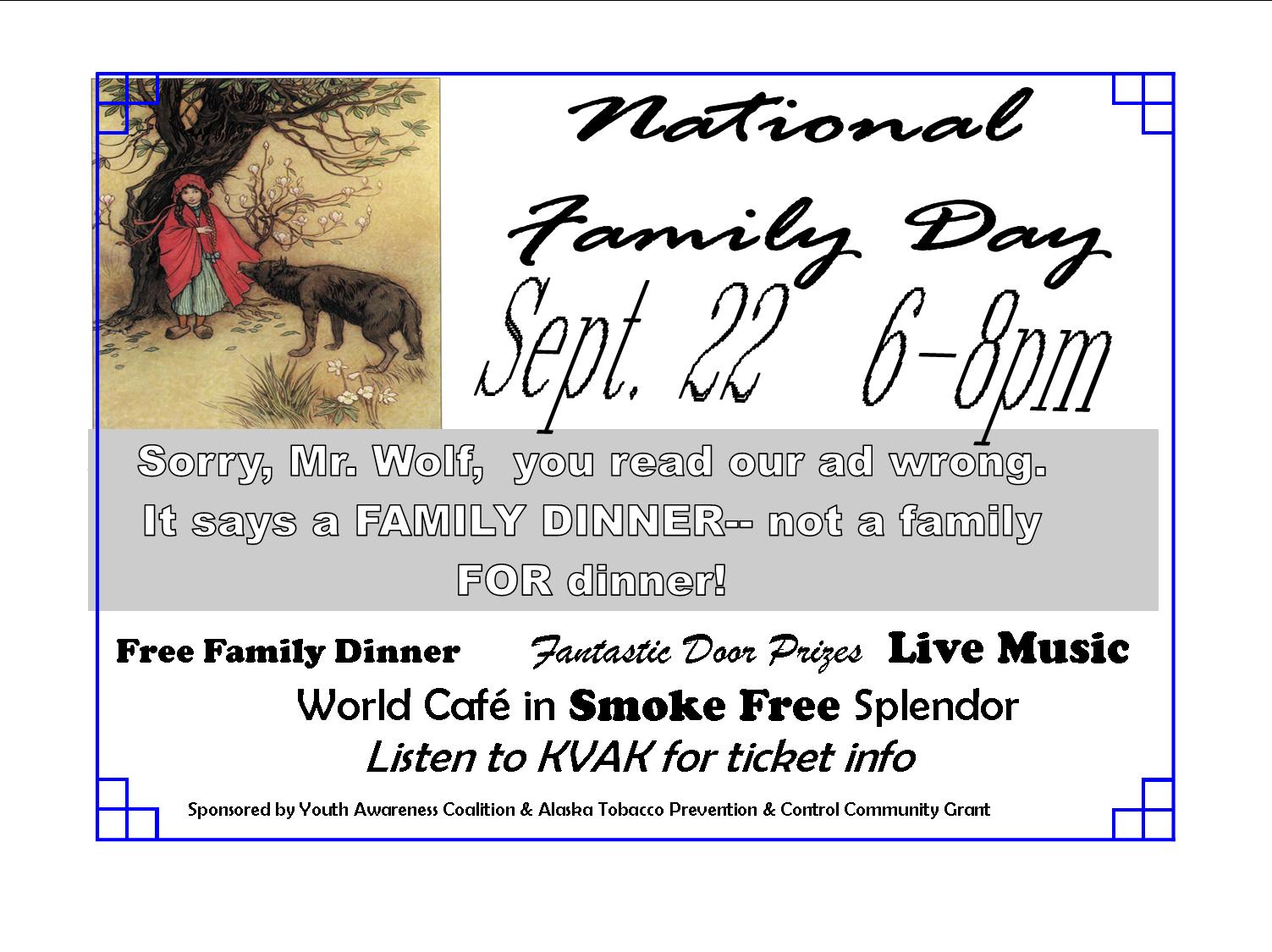
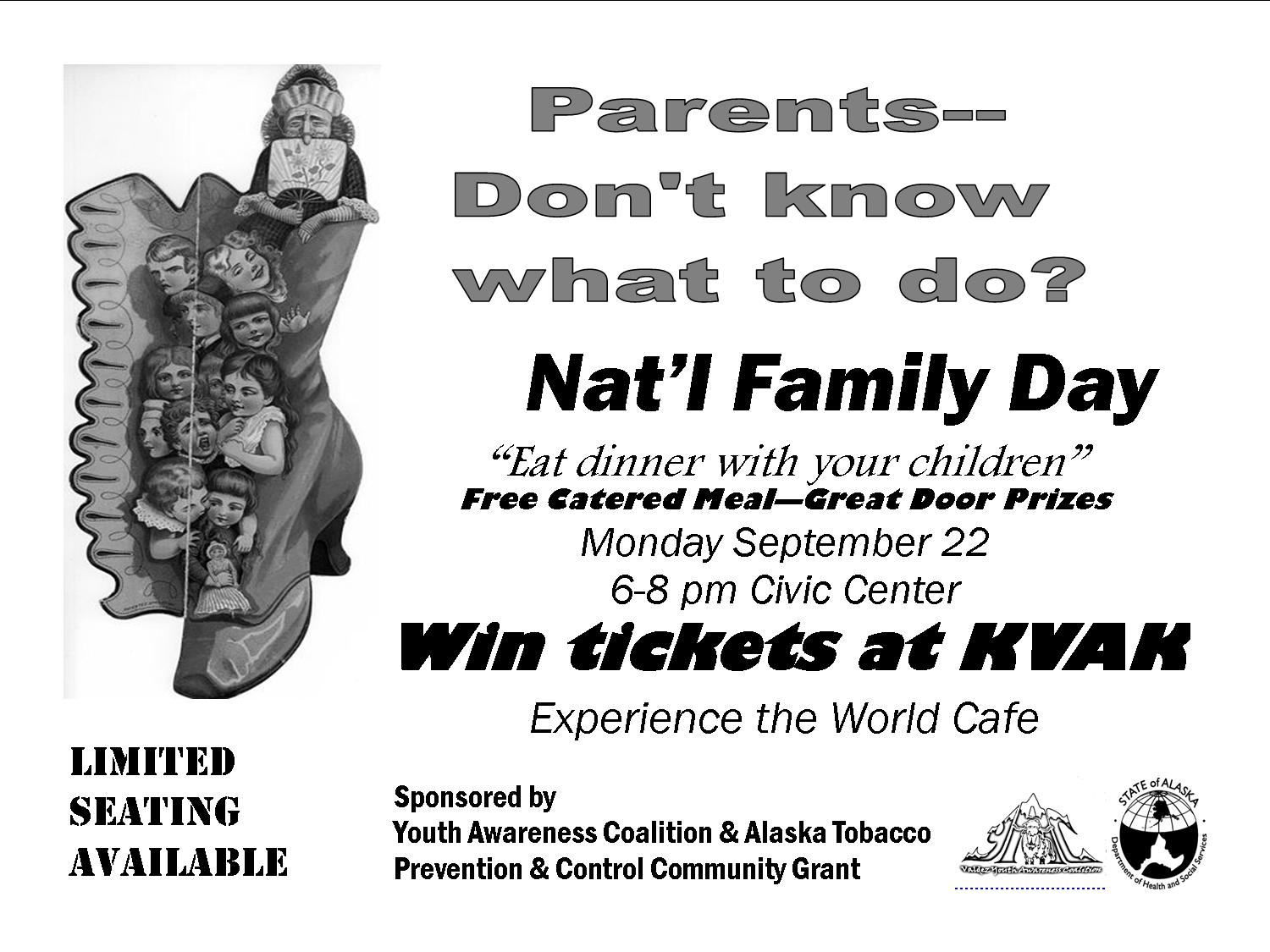
The Valdez World Café was introduced as a way for the entire population to come together and talk about the key issues and challenges that face them as a community. They scheduled the events for Fall 08 and Spring 09, with the first Café on National Family Day, September 22. The Café questions focused primarily on family health and well-being. Although the issues of suicide and isolation were not explicitly mentioned in the series of questions, it turned out they were part of the conversation at every table. As a result, the Spring World Café will focus explicitly on depression and suicide prevention.

Victoria and her team distributed flyers and ads designed to attract all sectors of the community. They wanted everyone to be represented and involved. These promotional materials are attached below, along with Victoria’s detailed report with statisics taken from the extremely informative exit surveys she did with Café participants.

Worldcafegroups

Here’s what Victoria had to say about the World Café, in summary:

“It was a fantastic success.  We had 20 families in attendance – 87 people that bridged a wide range of ages and socio-economic groups, and an amazing 17 volunteers that helped us that night. For a small community, that is a lot!

Our Family Day celebrations included a lovely catered meal with great door prizes to liven things up and set the mood. Our supporters were very generous and each child went home with a door prize!

Having it a family affair created an atmosphere of joy and reminded the adults that it is our job to create a healthy and safe community for these children.

People were very engaged in the conversations and several stayed past the two hours to
wrap up their conversations.”

Worldcafediscussion

Publichealthnurse

Familyday

This brief exchange came from a conversation Victoria overheard as she was walking around the room during the small group discussions:

“The question on the table was: “What makes a family strong?  Is a strong family the same as a healthy family?”

The table group consisted of 3 men and a woman.  All were professional and leaders of the community.  One of the men at the table related a story about his wife’s family.  He wondered how the same family can have 3 healthy daughters and one daughter who was so unhealthy.

Three of the daughters were professional women and the other bounced from job to job—in and out of rehab—but never could take care of herself.  How could one family have three successes and one loser?

At this point, the woman in the group leaned forward toward him and interjected—“No one is a loser”.  She stated that we all have times in our lives when things go bad for us, but that doesn’t make us a loser. She turned it around on him.  “What could you do to help her improve her life?”

The man became angry. He said, “This isn’t about me.” He sat back in his chair and folded his arms across his chest. She said, “If it is about your family—it is about you.” The other two were silent. It was as if the two speakers were totally alone in the room.

There were many interesting conversations, but this one seemed to focus on how baffling mental health issues are.  And, how in a venue like this, people open up to express differing views.”

* * * * * * *

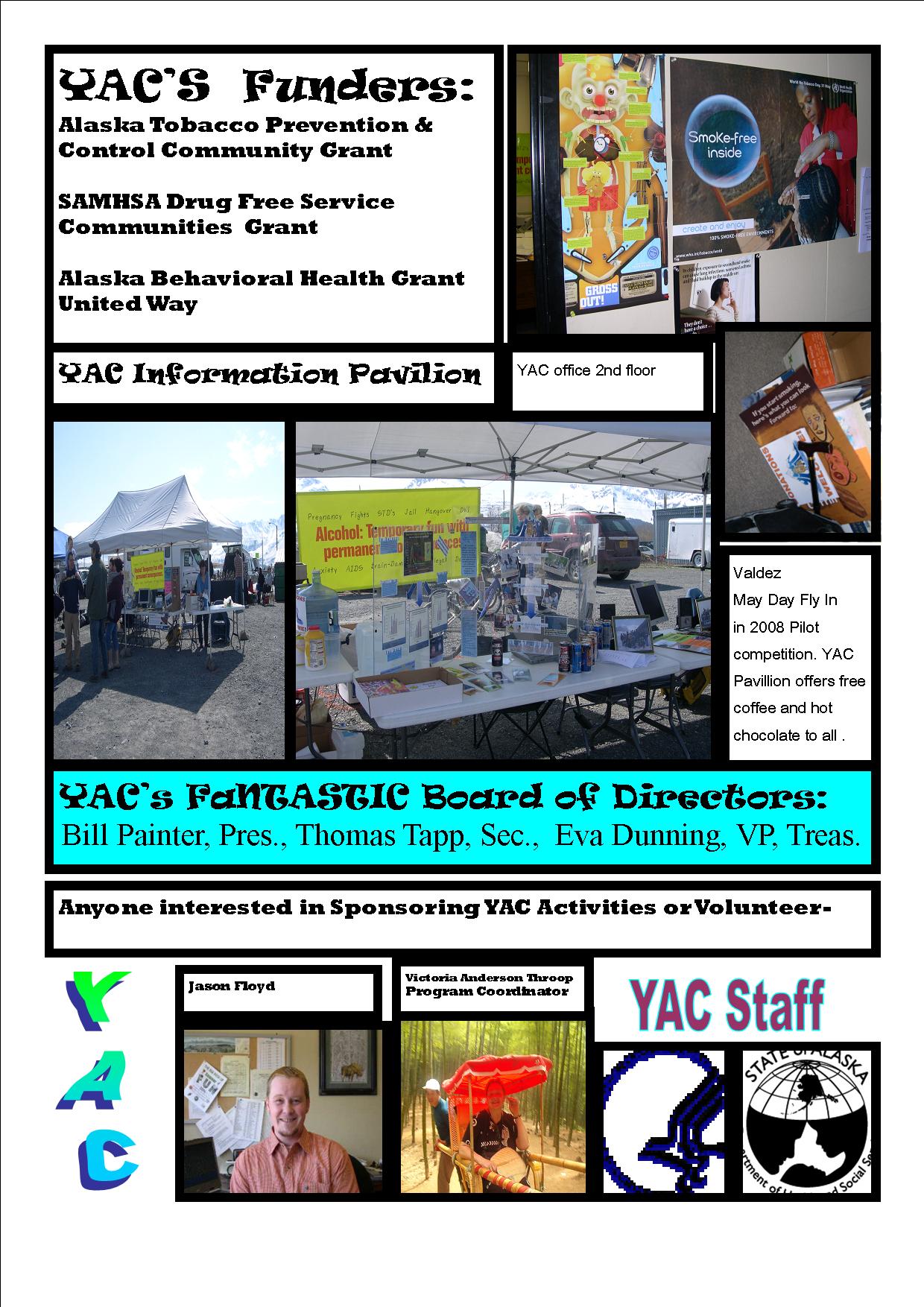
Jason Floyd, the Executive Director of the Valdez Youth Awareness Coalition (YAC) was instrumental in finding the funds for this World Café, which was supported by community grants from Alaska Tobacco
Prevention and Control, SAMHSA Drug-Free Service and Alaska Behavioral Health.

Full Report with Surveys
Download world_cafe_overview_and_statistics.doc


Promotional Materials
Download AProgram.jpg
Download postcard_invitations_portrait.docx

Download invitation2.doc

Download wlf_newspaper_ad.jpg

Download shoe_ad_half_new_shoe.jpg

Notes from Shambhala 2008

Hi everyone,

I’ve just recently returned from the Shambhala Institute for Authentic Leadership in Nova Scotia, where Tom Hurley, who is guiding the global evolution of the World Café network, led a module on Leadership in Emergent Networked Systems. I co- hosted, with Claudia Chender, a young leader from the board of Shambhala, an inquiry into future possibilities for the Shambhala Institute in the arena of multi-generational collaboration, a thread we had begun with the first Intergenerational Dialogues at Shambhala in 2004.

What we thought might be a small group of about 20 to explore the multi-generational possibilities became a group of more than 60 of all ages and stage of life. It was an exciting time, once again revealing immense interest in the possibilities that could emerge if we came together across the generations on behalf of accessing collective intelligence and wise action on issues of common concern.

Claudia stepped forward to join Samantha Tan, Ryan Feinstein and others to help both the Shambhala Institute and the World Café become global learning laboratories for true multi-generational collaboration, an effort which we hope to link to our research partnership with the Fielding Institute for Social Innovation.

All in all, was a wonderful time for me personally, as many friends from previous years were there, including Toke Moller and Nissen, who along with Chris Corrigan led a module on the Art of Hosting and Harvesting. I was asked by the Art of Hosting group to come to their module as a guest "storyteller" to share my sense of the "deeper work" of the World Café–seeing the possibilities of conversation as a co-evolutionary force for constructive change, and the powerful ideas that come when we create the conditions for what Finn Voldtofte, a World Café pioneer from Denmark, called the "magic in the middle"–that special state of collective consciousness–what some call "the field" that enables true creativity and innovation to reveal itself.

I was also deeply honored by the wonderful offer of Ravi Tangri to help inaugurate "World Café TV!".  Ravi spent the week filming varied aspects of the World Café so that we can begin to develop short videos (on You Tube, of course!)  of the World Café process, principles, and deeper pattern with the burgeoning
World Café community of practice around the globe.   Ravi and his wife Kathy Jourdain have been doing groundbreaking work integrating Otto Sharmer’s "Theory U Process" with the World Café in their work in transforming the health care system in Nova Scotia. I had the chance to meet with the leaders of this effort at their home the day after the Institute ended.  It was truly heartwarming to see how the World Café is serving these kinds of efforts.

I look forward to continuing to collaborate with Ravi Tangri, Nancy Margulies, Emmett Miller, and others to develop innovative ways to communicate the essence of the World Café and to invite others to play.

If you are interested in learning more about either the multi-generational work, or ways to spread the word about the World Café in your communities please contact us at .

Warm regards to all,

Juanita

The Conversation Continues in Bilbao

Inspired by the achievements of the Basque government and a number of
the world’s renowned architects,  World Café Europe held its second
European Gathering in Bilbao, Spain from June 5 – 7th. The Gathering’s
theme “Looking at Renewal with New Eyes: The Bilbao Experience”
attracted participants from as far away as Australia, Bolivia and the
United States to join in the conversation with citizens from all over
Europe.

This year 11 local World Café conversations with representatives from a
broad spectrum of sectors from society were held: education, health,
business, R&D, business, city and regional development, youth,
social services and the arts. Over 770 people from Bilbao and the
Basque country participated in these local World Cafés.

Two local World Cafés offer a special insight to the spirit of these
conversations with the citizens of the Bilbao and the Basque country: a
World Café with the Basque television (EiTB) and another in the Prision
Nanclares de Oca.

The topic of corporate social responsibility was the topic for the
Basque television’s World Café conversation.  This tri-lingual World
Café – Spanish, Basque and English – engaged 120 individuals to reflect
upon how the television station could more effectively fulfill its
purpose as a supporter of the Basque culture and community. Results of
these conversations will serve to inform the EiTB’s strategy for the
up-coming years.

Graphics

The prison of Nanclares de Oca provided a unique setting for a World
Café conversation. The director of the prision welcomed the proposal by
prision’s psychologist to host a conversation to discuss the topic
“Enhancing the atmosphere of the prision environment”.  Over 120 people
from in and outside the prision walls – prisioners, guards,
administrators, politicians, family members and victims – engaged in a
lively dialogue to voice their thoughts and recommendations. The
graphic recording for this conversation was a joint collaboration
between a current prisioner and a graphic recorder. Both the graphic
recording and harvesting of ideas will be used by the prision
management to create a better environment for everyone living and
working in the prision Nanclares de Oca.

Prison

Over 100 participants joined the conversations of the central World
Café on the topic of renewal. Using Bilbao as an inspiration, this
World Café was designed to inspire renewal in communities, cities,
and/or organizations by exploring their unique creative potential.  The
questions were aimed to generate energy and “chispa” in the
participants for renewal, enable them to “live” renewal on a personal
and collective level,  as well as enable them to jointly create new
knowledge and know-how to lead the renewal process. The  innovation of
a “Walking World Café” made its debut in Bilbao during this central
World Café. Based on questions about the renewal process formulated by
the participants themselves, the role of innovation, creativity, nature
and tradition in Bilbao’s  renewal process were explored by teams of 4
people. The  Guggenheim Bilbao (by the Architect Frank Gehry), the
Zubizuri Bridge (by the architect Santiago Calatrava), the park of
Doña Casilda and the Palacio Euskalduna (former site of Bilbao’s
shipyards) all served as inspiration for these conversations. Jumping
into the Cypernetic Fountain in the park added to the joint learning
experience for one group!

Cafe

World Café Europe is thankful to innobasque – The Basque Agency for Innovation – for their sponsorship of this year’s Gathering.

Mark your calendars! Next year’s Gathering will be held in late May 2009 at a location to be announced this fall.

Latin Palomilla April, 2008 (in English)

Dialogue Culture, Evolution, Fire and Consciousness
A photograph of the experiencie of the latin palomilla, april 2008
by Fernanda Ibarra

Howard Bloom says ‘There is nothing, absolutely nothing individual about the universe ‘ and as he says so he evokes our social essence, the form in which we stretch from the individual to the collective. From the protons which in their desire for an electron formed a circle that produced something never imagined; the atom. We have 14 billion years of surprises, much has happened since the atom, living processes continued their journey, evolution continued to discover how to organize cooperative groups every time more complex. We can all recognize what it means to have the capacity for experience, sensing, environment stimulation, correspondence, attraction and repulsion which are essential qualities which contribute to the organization, to the cooperation in between simple unities (quarks and molecules) up to the most complex (human beings) that conform our universe. Its manifestation in society was our capacity to move from the clan to tribes to villages to nation-states and from there to the possibility of expansion in a global scale, or is it universal?

In the heart of evolution we find communion, movement to more interdependence and cooperation. Human beings, conscious of consciousness search for quality in experience, rhythm, creative action, synergy, flow. We long for it to be in groups, in collectives where we can ‘operate’ from source, in favor of the discovery of our highest potential.

World Café contributes to this goal. Within the discovery of a new story, in the support of a transition that threats life to one that is life-affirming. World Café helps us to elevate the perception of ourselves and our sense of purpose. Same that builds to the intention for organizing an event for the ‘Latin Palomilla’ of World Café in April 2008. Its virtue is the exploration of ‘how to create a culture of dialogue in Latin America’. A noble and necessary effort in this crucial time in human history where we are searching for global sustainability within this evolutionary spiral that leads towards more cooperation and unity.

Carlos Morán from the Mexican academy of engineering tells us "Interdialogue is the key in between couples, families, industries, society, parties. In between children, parents and the educators. In between all instances of human interaction. Quality in dialogue makes a huge difference. In order to face our current global problems it is a priority to build a society which honors a culture of dialogue". Let’s make a first pause, what does it mean, quality in dialogue?

The voices of the Palomilla give us several components like: define spaces of listening (safe containers), the capacity to integrate perspectives, beliefs, forms of being/doing. The skills to hold difficulty in a moment and transcend it. Conscious communication that emerges from ways of listening which are creative instead of reactive. An AHA! moment was to talk about agreements, and how the goal of a dialogue shouldn’t necessarily be to reach an agreement but the opportunity for a larger understanding of the perspective and truth of the other as a way of respect to his/her freedom and expression. The questions which emerge in me are, which of the named capacities are collective? which ones begin in the individual?. If we don´t seek agreement then, how can we hold the creative tension in favor of the emergence of something new?

The limitations are sometimes invisible to the non-trained eyes. Invisible architectures like language, mental models, world views and the function of the mind/brain itself. Let me give you an example. In the most recent report of the Institute of Noetic Sciences called ‘Changing the Story of our Future’, which thoroughly explores our capacities for change, I read about a group of scientists which presented to a sample of republicans and democrats a series of contradictory statements made by both John Kerry and George Bush and asked each group to rate how contradictory those statements were. Scientist were measuring the participants brain activity while this occurred. In the results they didn’t see any increased activation of the parts of the brain normally engaged during reasoning. What they saw is a network of emotional circuits lighting up! It seems that the brain can learn very little from new data when beliefs are challenged. The participants were literally censoring their cognitive dissonance. This findings tell us a lot about the need for skills in conscious communication to benefit any collective we as individuals which to contribute to. Carlos Mota names something vital "There are inner walls we need to break. They are not easy to see. They hurt more".

Let’s continue with our exploration of the event and listen to the voice of Guadalupe Martinez de León from the University of Monterrey and member of the Latin Palomilla which makes a powerful description "Quality in dialogue allows for the magic of collectivity, which is aligned to human will, to emerge". This experience was widely expressed during our time together.

When we asked Juanita Brown about the unique contribution of Latin America to the Global World Café she answered "What Mexico and Latin America can give is that this Latin cultures really understand what magic is, magic in conversation, with truth, authenticity; like the one we have when we take coffee with our families. This kind of authenticity, intimacy, human warmth can be a large contribution to other cultures which are colder. In Latin America we dialogue with pleasure, joy and sense of human warmth. The Latins can offer this soul, heart, joy and expression so unique of Latin cultures.

There was fullness and exceptional moments within the fire of divergence, where the presence was profound, the voices said "this is real", this is what we have to hold and transcend. We are a microcosm of what we see outside. Carlos Mota speaks about two possibilities in the face of disagreements; either to collapse the process or right in the boundary generate creativity. He reminds us that this is the moment to create those capacities that will help us in facing any possible scenarios. He gives us the question "Do I have what I want to give?"

There are many moments to relate. One day and a half expanded showing us the relativeness of time. When we focus, the possibilities to generate open and time contributes with a slow step. This event was a deep breath in the history of World Café. A door for Latin America.

There is enough evidence to say that a transformation in global scale is on its way. Our future awaits us. Let’s hold the lessons of evolution where communion, cooperation and diversity have been leading the creation of new forms impossible to imagine. Let’s favor dialogue and conscious communication as a process for our creative explosion in favor of human potential and a glorious future for generations to come.

Fernanda Ibarra
Collective intelligence agent
Catalyst of evolutionary projects

Extraordinary World Café at Taiwan SoL Conference

World Café steward Ulric Rudebeck was the team leader for the hosts of a four day conference sponsored by the Taiwan Society for Organizational Learning in November 2007.

Ulric and his team members Ken Homer, Andri Lehn, Stephen Meng, Samantha Tan and Morel Foreman worked with SoL coordinators to create an extraordinary experience for everyone gathered there.

This is their story, beautifully written and illustrated by master graphic facilitators, and an Executive Summary of this special event:

Download tsol_world_cafe_reflections.pdf

Download tsol_cafe_executive_summary.pdf

Rockridge Institute World Cafe in Second Life

Secondlife
Creating online World Cafés that are based on the same principles and practices as in-the-flesh Cafés and access the same collective intelligence, or ‘magic in the middle’ is a project I and others have been working on for a while now, using a variety of online tools and methods. Here’s a story about a World Café I hosted using one of those tools, Second Life:

Second Life is what’s called a ‘virtual world’; a 3-D environment where anything that happens in ‘real life’ (and more) can be played out. One popular business use is rapid prototyping, and innovative models for new social behaviors can also be quickly

formulated and pioneered there. Many technologically savvy companies and organizations already have a presence in this Brave New World, and recently one of them contacted us to see if we could help host a conversation ‘inworld’ after a ‘live’ presentation they were delivering via conference call.

That organization was George Lakoff’s Rockridge Institute, and I was pleased to have the opportunity to work with Director of Public Affairs, Sherry Reson to design and host a World Café in Second Life on how virtual worlds might be used to further progressive values in real life.

There have been other brief World Café forays into Second Life, but this was the first I know of that used a process so close to the ‘real’ World Café format.

Together, we set up a hospitable World Café space near the Rockridge Second Life offices, complete with 6 round tables with vases of flowers, each surrounded by 4 comfy chairs. We arranged the tables within ‘earshot’ so we could use the collective ‘chat’ feature for the introduction and harvest in the large group, and we utilized group IM chats for the table conversations, each round anchored by a host.

The only thing we were missing were tablecloths that we could ‘doodle’ on, and the ability to watch a ‘real time’ graphic recorder create a visual harvest right before our eyes. But World Café GiGi (Girl Geek) Nancy White (Choconancy Lupino in Second Life) served as our graphic recorder, and she created this gorgeous graphic from our harvest, which she immediately posted to Flickr:

Nancysgraphic
 

One of the unique benefits of a Second Life World Café is that there is a transcript automatically produced of the entire contents of each conversation. This potentially lends itself to some creative future harvesting possibilities, but for now the ‘raw’ files are available and you are welcome to read them.

This World Café was actively supported by our friends at Grove International; Michelle Paradis, who worked with Sherry and I in setting up the space, and David Sibbet, who attended and served as host for his table. David, whose Grove Consultants International has done extensive building in Second Life, has offered a dedicated space in the beautiful Grove International galleries for World Cafés. We look forward to exploring the collaboration with him and more ‘inworld’ World Cafés in the future.

If you are interested in having a World Café as part of your event in Second Life, or working with the World Café team to provide hosing support, please contact me by email, or find me inworld as “Lucida Skytower”. You can go into the World Café page in the Second Life wiki to learn more, and if you have an avatar in Second Life, please join the World Café group there!

Reasoned Argument

This video makes hay with the question of whether or not global warming is the threat that environmentalists are warning us all about: